ZyptAI Convert
The SAP data conversion workstream as a system, not a folder of spreadsheets. The people who know the data ask their own questions in plain English — and every row is judged against what each step declared it would do.
One platform surface. Shared project memory. Shared identity, governance, and audit.The Business Stops Being a Spectator
Data conversion fails on the cleansing loop, and the cleansing loop fails because the people who know the data cannot reach it. Every question routes through someone who writes SQL; every answer arrives weeks late as a spreadsheet nobody can act on. Convert puts the question in their hands — and then takes the reporting of progress out of everybody’s hands, because the product decides what got fixed.
Raise a request and wait for someone who writes SQL. The question is only as good as the queue it sits in.
Type it in plain English. Rows come back with the generated SQL shown beside them, editable if you want it tightened.
It was an email, or a query in somebody’s personal workbook. By the next mock cycle it is gone and gets rebuilt from memory.
Save it as a check. It re-runs unchanged every cycle, with this run, the previous run and the previous cycle’s final run side by side.
A spreadsheet arrives by email weeks after the extract, addressed to "the business".
A finding with a named owner, dispatched to a named person. "The business" is not a record of anything.
Four thousand rows to read, with no indication of whether that is four thousand problems or one.
Grouped by distinct value, commonest first — ten country codes to fix, not ten thousand rows to scroll.
A status update from the person being measured on the status update.
The next extract lands and the product closes what is genuinely gone. Anything still present stays open.
Agreed verbally in a design authority meeting and remembered differently by cutover.
A disposition with a name, a date and a reason — and it lapses for review if the underlying data moves.
Ask in English. Get Rows.
Type a question against the landed legacy data and get rows back, with the generated SQL shown beside them. Keep it as a check and it re-runs unchanged every cycle, with the previous run and the previous cycle sitting next to the answer.
A Named Person, Not "The Business"
Every check and every finding carries an owner. Results dispatch grouped by distinct value, commonest first — so a business owner gets a handful of values to fix rather than thousands of rows to read.
Fixed Is Decided by the Product
A finding is a rule and a record key, and that identity survives every reload. Present in one run and absent from the next, it closes itself. Nobody reports progress that did not happen.
Every Row Accounted For
Every step declares what it does to the row count, and the engine judges the real counts against the declaration. A legitimate one-to-many expansion does not read as a fault, and an accidental one does.
Your Spec, Read Clause by Clause
Upload the functional spec and proposals arrive with the clause quoted beside the generated SQL. Incomplete clauses are blocked, never guessed — and target fields the document never mentions are reported as a gap in the spec.
A Decision, Not an Ignore
Accepting or excluding a record records who decided, when, and why — bound to the values that justified it. If those values change on a later load, the decision lapses and returns to review with its history intact.
The Third Cycle Costs a Fraction of the First
Definitions live at project level and data at run level, so a reload never costs you your logic. Seed the next engagement from the last one: the design carries across, the evidence never does.
Your Tenant. SQL Only.
An Azure Managed Application inside your own tenant, staging in Azure SQL. No arbitrary code execution, and reads run under a database principal granted the project schemas and denied everything else.
See the Product
The Question Is the Heading
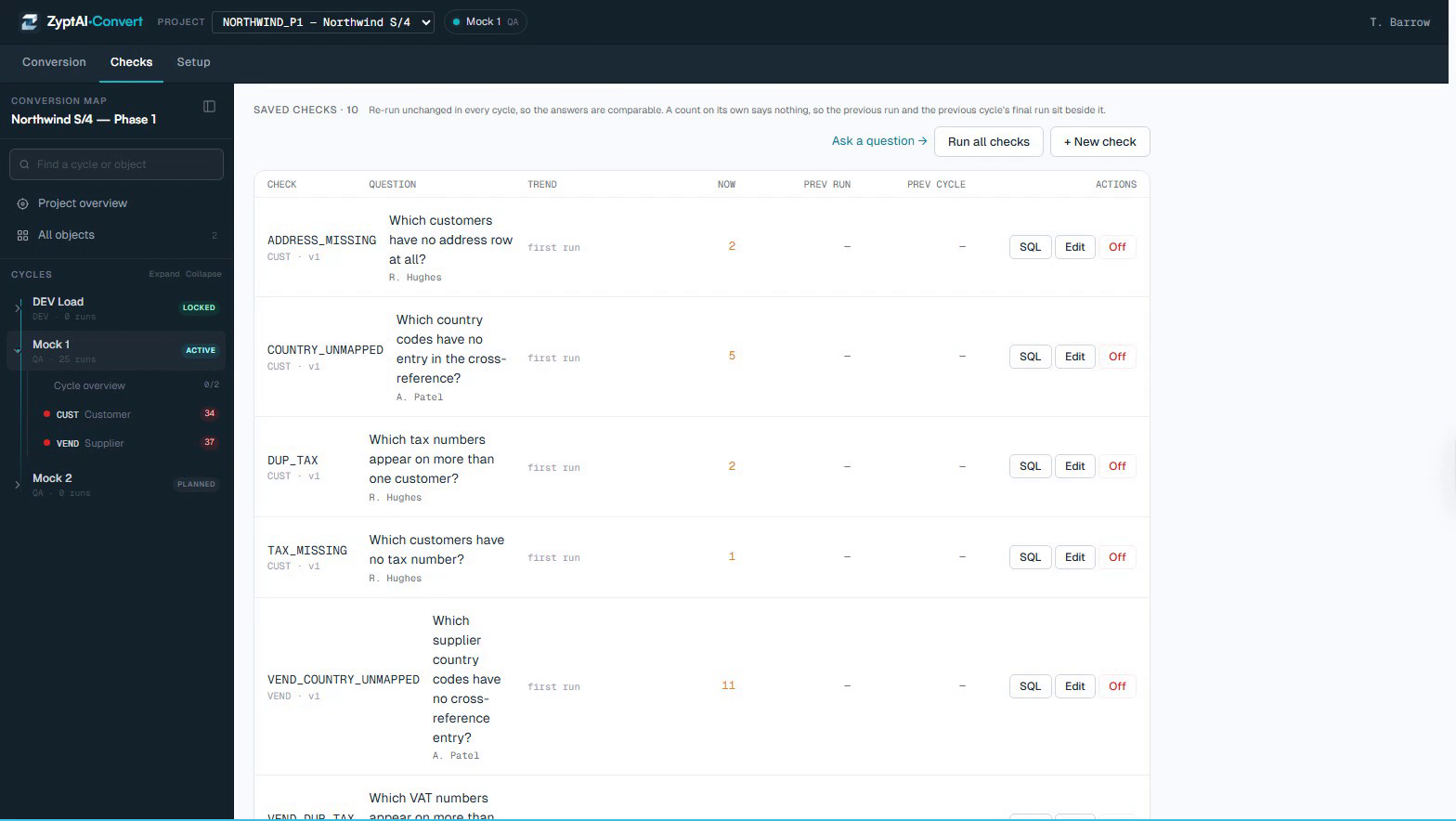
Saved checks read as the question the business actually asked — "Which customers have no tax number?" — each with an owner and the count from the previous run and previous cycle beside it. On a first run those columns read as dashes, because a count on its own says nothing.
The Product Refuses Its Own Sign-Off
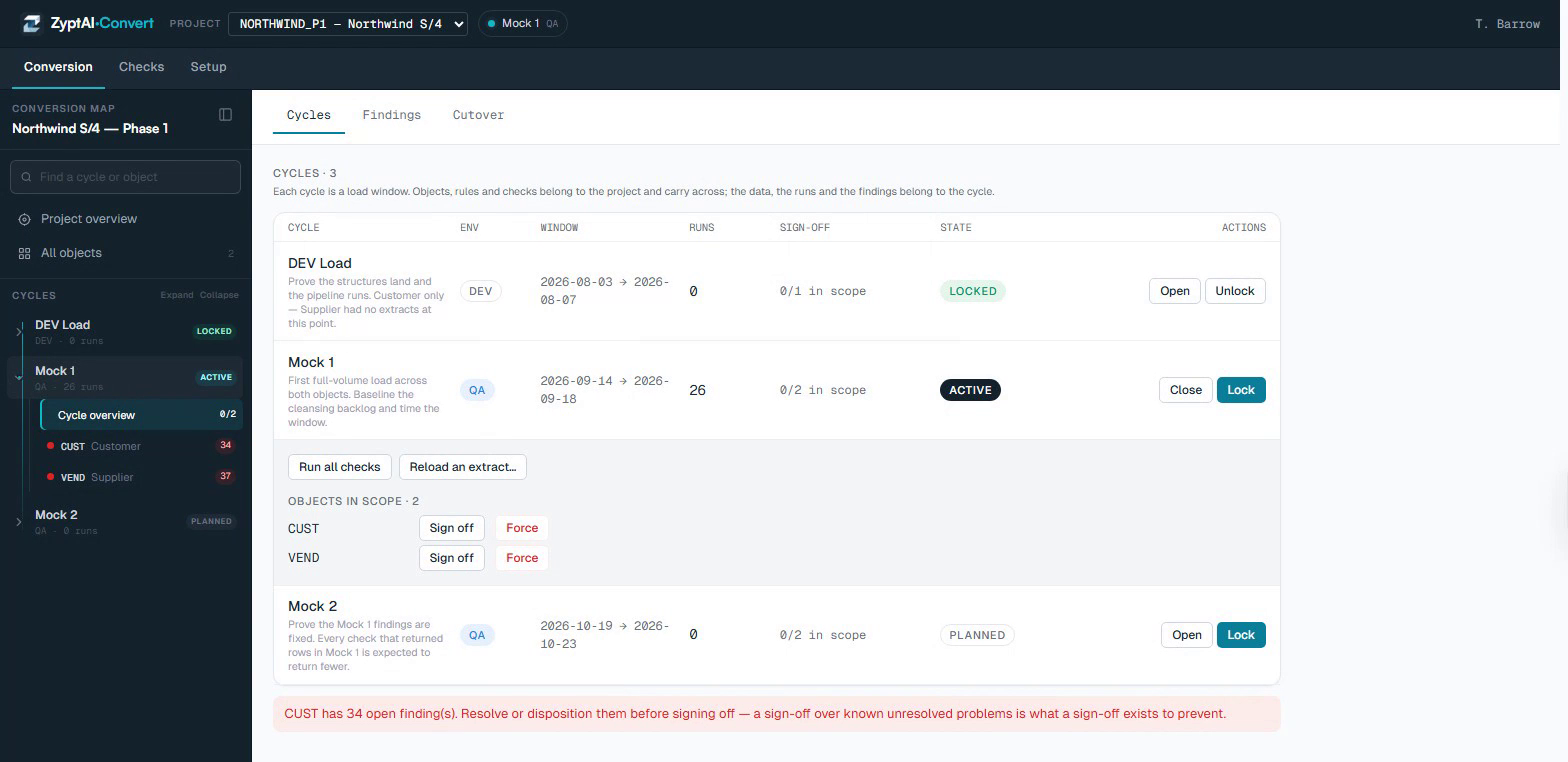
Thirty-four open findings, so the object cannot be signed off. A sign-off over known unresolved problems is exactly what a sign-off exists to prevent. A lead can force it — and that override is recorded against the cycle with a reason.
Twenty-One In, Eighteen Out — Every Step Judged
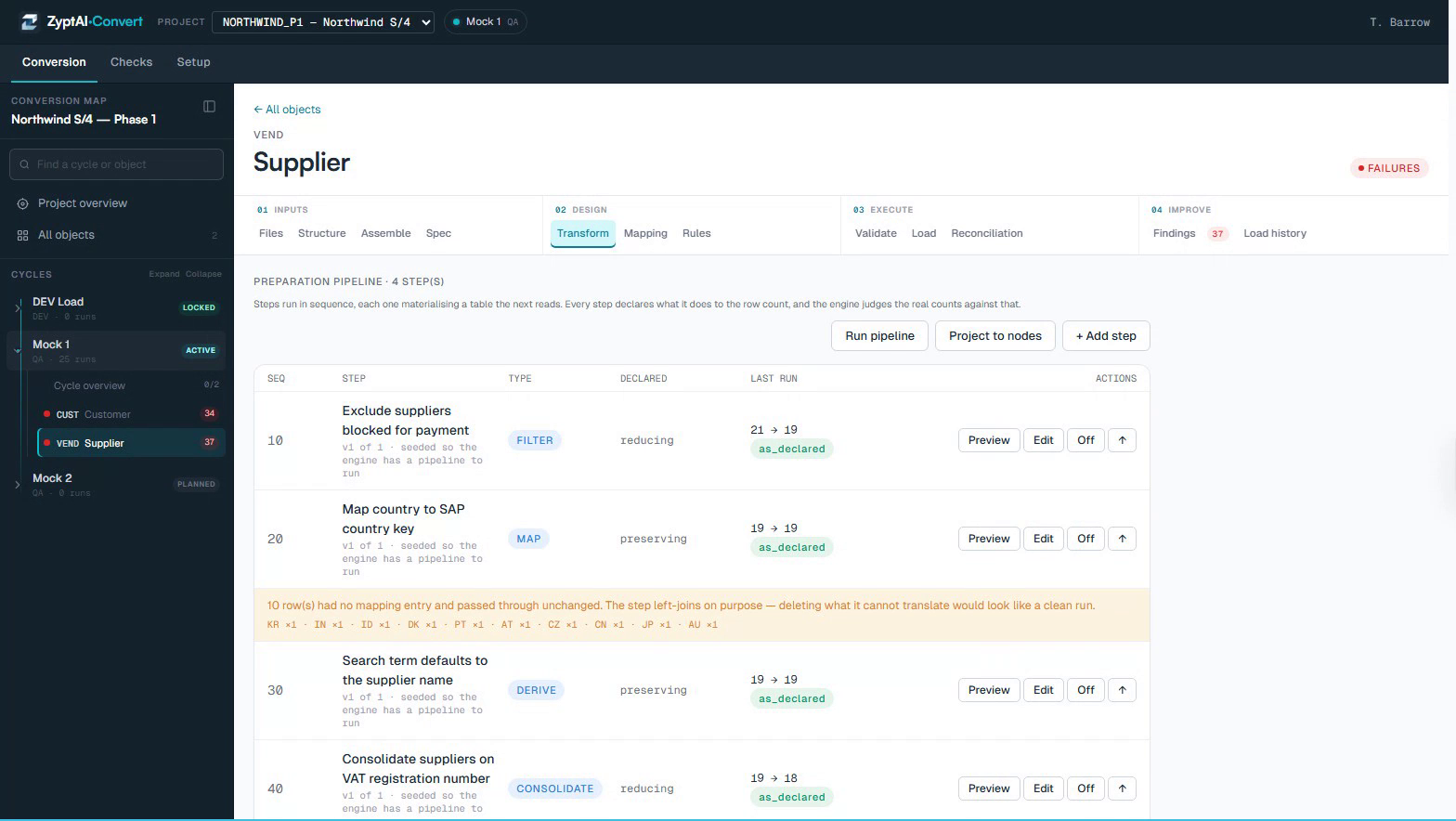
Each step declares whether it reduces, preserves or expands the row count, and the engine judges the real counts against that declaration. Ten rows that found no mapping entry are named rather than dropped: deleting what it cannot translate would have looked like a clean run.
The Silence Is the Finding
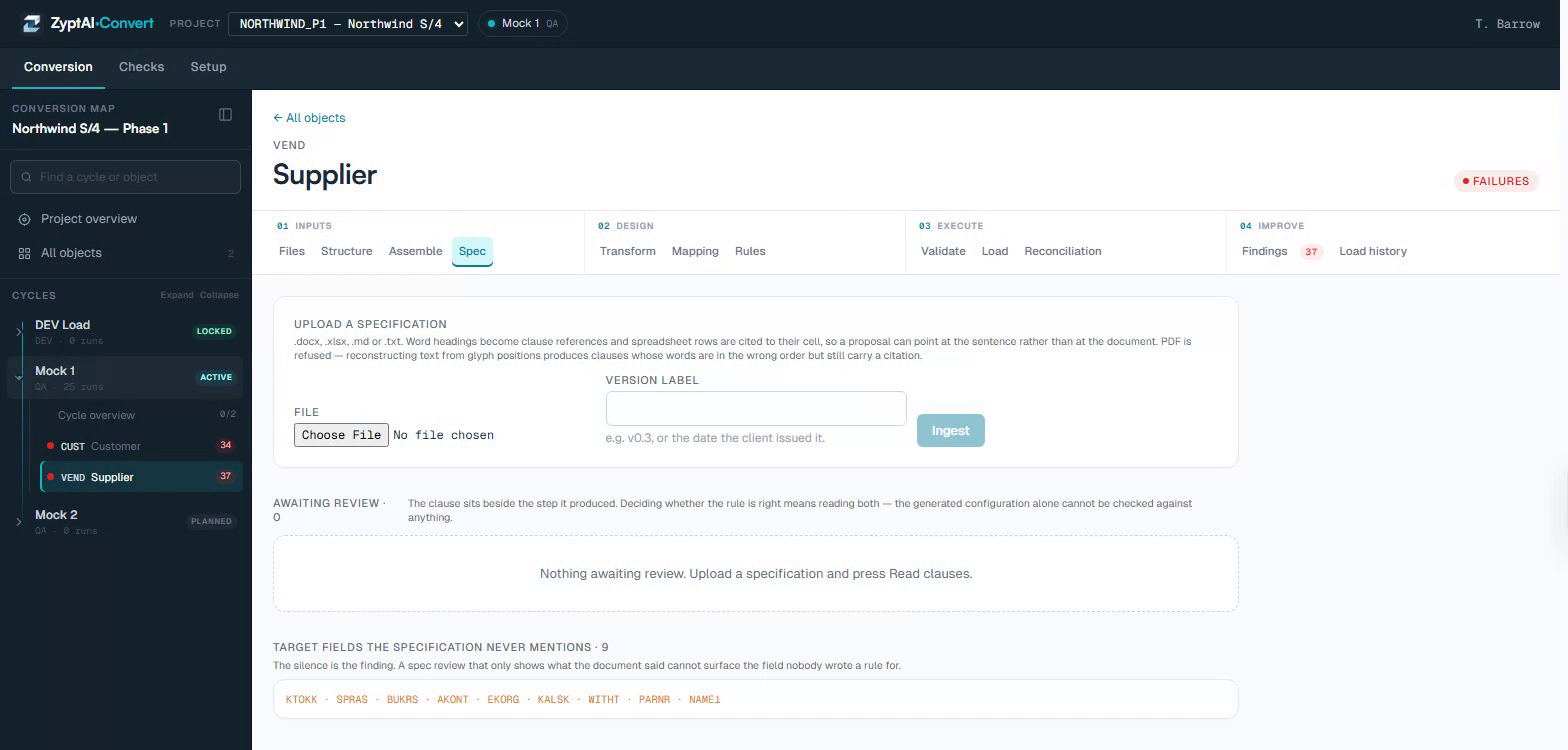
Nine target fields that the functional specification never mentions at all. A spec review that only shows what the document said cannot surface the field nobody wrote a rule for — and telling a functional lead that in week two is worth more than finding it in week nine.
Convert prepares, validates and evidences the data; it does not post to SAP. Load-ready output lands in Azure SQL inside your tenant, which SAP BODS can read directly as a source — no file to carry in that path. For the S/4HANA Migration Cockpit, Convert exports the package per target node, and refuses to export at all where a required field is unmapped, naming the fields. The returned result file is read back in and matched against source keys, so the SAP-assigned key lands on the record it belongs to.
Why Not the Alternatives?
Other tools exist. None were built for SAP teams inside Azure.
The real incumbent. Cleansing logic lives in personal spreadsheets, gets rebuilt from memory at every mock cycle, and only its author can change it. Progress is whatever the status column says it is.
The destination, not the workstream. It accepts a package and reports what it rejected. No cleansing loop, no findings lifecycle, no memory between cycles — and no way for a business owner to ask a question.
Capable migration suites priced and staffed for large systems-integrator engagements. Out of reach for programs that will never license one, and none of them puts the question in the hands of the people who know the data.
Built for steady-state pipelines between running systems. A conversion workstream is measured in mock cycles, findings burn-down and cutover readiness, and none of that vocabulary exists in a generic ETL tool.
Business owners ask their own questions in plain English and keep them as checks that run every cycle. Findings close themselves when the data is genuinely fixed. Every step is judged against what it declared. Your functional spec is read clause by clause and its silences reported. All inside your Azure tenant — and the second engagement starts with the first one's asset library.